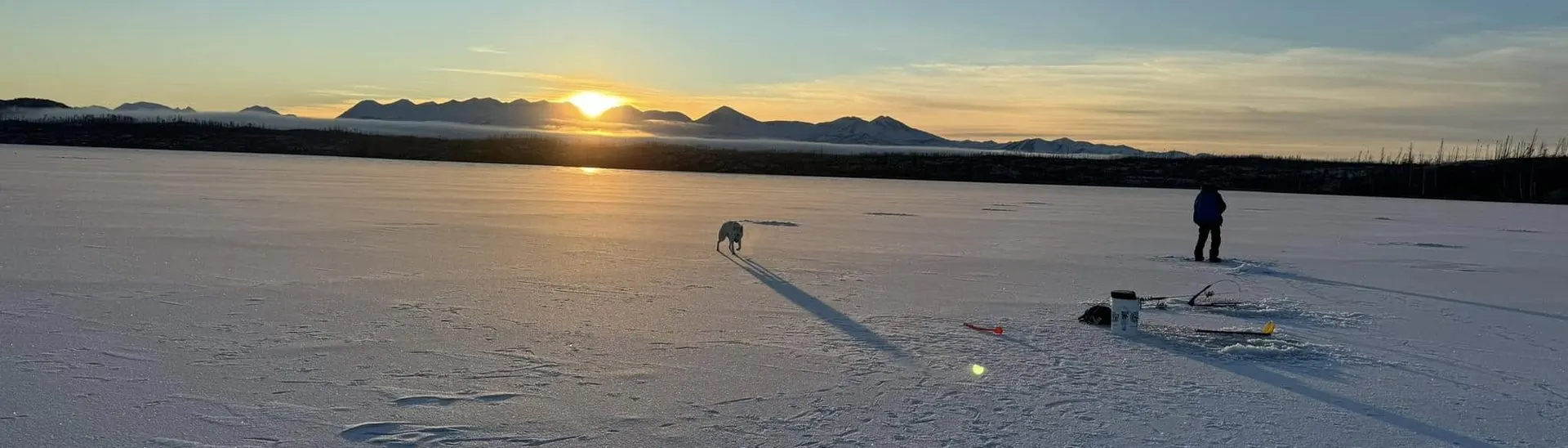
Ice fishing on the Kenai Peninsula usually runs from late December into March, on small stocked lakes where the ice forms early and evenly. The Alaska Department of Fish and Game stocks 28 lakes on the Peninsula with rainbow trout, and some with landlocked salmon, Arctic char or lake trout. Anglers 16 and older (nonresidents) or 18 and older (residents) need a sport fishing license, and licenses expire on December 31. You may fish two closely attended lines through the ice. The Alaska Department of Fish and Game doesn't monitor lake ice, so check it as you go. This guide covers the lakes, the rules, burbot, ice safety and daylight, with our guides' current ice report.
Current ice conditions
Our first ice report goes up when the lakes freeze, usually in mid-December. We check the ice on Sport, Longmere, Spirit (Elephant), Island and John Hedberg lakes and post what we measure here.
Our guide checks the ice again before every trip. The Alaska Department of Fish and Game doesn't monitor lake ice, so if you go on your own, check it yourself as you go.
When the ice fishing season runs
The season depends on the weather, and it’s different every winter. Small, shallow lakes near Soldotna and Kenai usually freeze first, and anglers are commonly out from late December through March. Big, deep or wind-exposed lakes freeze later and less evenly, and some barely freeze at all in a mild winter.
The Alaska Department of Fish and Game points out a catch: the fishing is often best just after freeze-up, when the water holds the most oxygen, and again just before breakup. Those are also the most dangerous times to be on the ice. Early and late in the season, check the ice often and stay close to shore until you’re sure of it.
The Kenai Peninsula's stocked lakes
The Alaska Department of Fish and Game stocks these 28 Kenai Peninsula lakes (2026 regulations summary). Most get rainbow trout; some also get landlocked salmon, Arctic grayling, Arctic char or lake trout. ADF&G notes that its grayling program has been suspended for lack of funding, so a grayling listing may only mean fish left from earlier stockings.
| Lake | Stocked with |
|---|---|
| Arc | landlocked salmon, Arctic grayling |
| Aurora | rainbow trout |
| Barbara | rainbow trout |
| Cabin | rainbow trout |
| Carter | rainbow trout, Arctic char |
| Centennial | rainbow trout, landlocked salmon |
| Chugach Estates | rainbow trout |
| Douglas | rainbow trout |
| Elephant (Spirit) | rainbow trout, landlocked salmon, Arctic char |
| Encelewski | rainbow trout |
| First | rainbow trout |
| Island | rainbow trout, Arctic char |
| John Hedberg | rainbow trout |
| Johnson | rainbow trout |
| Long | rainbow trout |
| Longmere | rainbow trout, landlocked salmon |
| Loon | rainbow trout |
| Lost | lake trout |
| Meridian | rainbow trout |
| Rainbow | rainbow trout |
| Roque | rainbow trout |
| Scout | rainbow trout, Arctic grayling |
| Sport | rainbow trout, landlocked salmon |
| Thetis | rainbow trout |
| Tirmore | rainbow trout, Arctic grayling |
| Troop | rainbow trout, Arctic char |
| Upper Summit | rainbow trout, Arctic char, lake trout |
| Vagt | rainbow trout, Arctic char |
The lakes we fish near Soldotna
Our guided ice fishing trips use five of these stocked lakes, all on the road system around Soldotna, Kenai and Nikiski:
- Sport Lake, Soldotna: rainbow trout and landlocked salmon. A local favorite, close to town.
- Longmere Lake, Soldotna: rainbow trout and landlocked salmon.
- Spirit (Elephant) Lake, Kenai: rainbow trout, landlocked salmon and Arctic char.
- Island Lake, Nikiski: rainbow trout and Arctic char.
- John Hedberg Lake, North Kenai: rainbow trout.
Getting onto the ice: access, the refuge and state parks
Public access. Most stocked lakes have a public access point or a small parking area off the road, but much of the shoreline around many lakes is private. Use the public access, park where it’s allowed, and don’t cross private land to reach the ice. Plowing varies through the winter. Before you drive down from Anchorage, check the Sterling Highway on Alaska 511.
The Kenai National Wildlife Refuge covers much of the central Peninsula, and its rules for winter travel are strict. Snowmachines are allowed only in the winter months, only once the refuge declares enough snow cover, and not everywhere: many lakes and canoe-system areas stay closed to them. A few refuge lakes are open to licensed highway vehicles and snowmachines for ice fishing access, entering by the boat ramp. Off-road vehicles such as ATVs aren’t allowed on the refuge, even on lake ice. The refuge announces each winter’s opening, so check its current rules before you go. Commercial guides need a refuge permit.
State parks. Some lakes, such as Johnson Lake, sit inside state recreation areas, which have their own parking, fee and vehicle rules. Check with Alaska State Parks.
Shelters. Portable ice shelters are allowed on all waters. A permanent ice house needs the landowner’s or land manager’s approval. On the refuge, you may not leave property unattended for more than 72 hours outside designated areas without a permit.
Licenses, lines, bait and limits
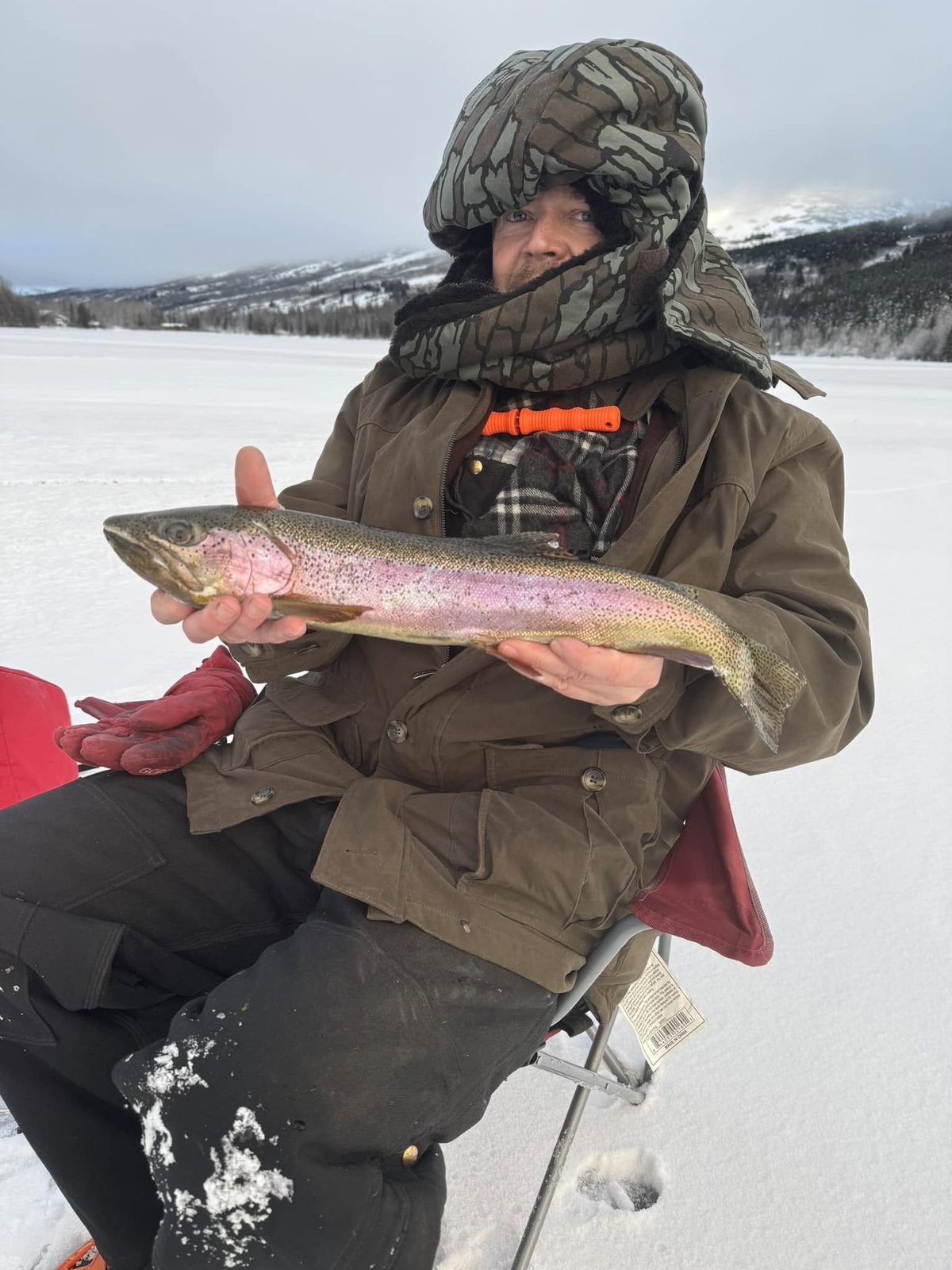
- License. Alaska residents 18 and older and nonresidents 16 and older need an Alaska sport fishing license, in fresh and salt water. Carry it on paper or on your phone. Licenses run on the calendar year and expire December 31, so a January trip needs the new year’s license. Buy one online from the Alaska Department of Fish and Game.
- Two lines. When ice fishing, you may fish two closely attended lines, each with one hook or one lure. Extra gear is allowed only for burbot (and pike) where the regulations allow it.
- Bait. Live fish may not be used as bait in fresh water. In Kenai Peninsula lakes, bait and multiple hooks are generally allowed, but check the rules for the lake you fish. Don’t use corn: ADF&G advises against it because it harms fish.
- Limits. Limits for rainbow trout and char aren’t the same everywhere on the Peninsula, even between nearby lakes, because they depend on which waters the lake belongs to. In stocked lakes, landlocked salmon have a limit of 10 a day and 10 in possession, combined with other salmon. Always check the current regulations booklet for the lake you’re fishing.
- Emergency orders. ADF&G can change the rules on a lake at any time by emergency order, for example to close a lake to keeping fish. Check for current emergency orders before you go.
Burbot through the ice
Burbot are a freshwater relative of cod, and a winter fish on some Alaska lakes. ADF&G’s ice fishing advice is to fish for them in the evening, on gravel bars, usually in less than 25 feet of water.
- Limits: on the Kenai Peninsula and in Kenai River tributaries, 2 burbot a day and 2 in possession, with no size limit (2026).
- Set lines: set lines for burbot are allowed only on waters where the regulations allow them, so check the lake first. Where they’re allowed, the general rules are: no more than 15 hooks or the daily burbot limit, whichever is less; single hooks with a gap of more than ¾ inch; the line resting on the bottom; each line labeled with your name and address; and each line checked at least once every 24 hours.
- Hidden Lake is closed to burbot fishing all year.
Most stocked lakes near Soldotna are rainbow trout lakes, and our guided trips fish for trout and char rather than burbot.
Ice safety
Check the ice yourself. The Alaska Department of Fish and Game doesn’t monitor lake ice. Check the thickness yourself with an auger or a spud bar as you walk out, and keep checking.
The National Weather Service’s general guide for new, clear ice:
| Clear ice | General guide |
|---|---|
| Under 2 inches | Stay off |
| 4 inches | May hold a person walking |
| 5 inches | Small groups |
| 12 inches | Medium trucks |
Ice is never 100% safe, and these are guides, not promises.
What ADF&G’s ice fishing leaflet says to watch for:
- Clear ice is strongest. Cloudy, white or bubbly ice is much weaker.
- Snow insulates, so ice under snow is often thinner.
- Inlets, outlets and springs thin the ice from below, and cause overflow: water hidden under the snow on top of the ice.
- At freeze-up the ice is thickest near shore; at breakup, in the middle.
- Big lakes are unpredictable. On large lakes, ice can be three feet thick in one place and an inch thick a step away.
- Driving on ice: go slowly (under 10 mph), with windows open, and spread vehicles out.
- Carry ice picks on a cord through your jacket sleeves, and dry socks and boots in case of overflow.
- Heaters: use only ventilated heaters in a shelter. Carbon monoxide builds up fast in a closed shelter.
Winter daylight
Daylight is short on the Kenai Peninsula in midwinter. Around the winter solstice in late December, the sun rises in mid-morning and sets in mid-afternoon, and the light is low all day. The days lengthen quickly from February, and by March there’s plenty of light for a longer day on the ice. Plan to be on the ice in the middle of the day in December and January (our guided trips run about 10:30 AM to 2:30 PM), carry a headlamp, and look up sunrise and sunset for your date before you go.
Are there pike on the Kenai Peninsula?
No. Some fishing websites still list northern pike as a Kenai ice fishing species, but the 2026 ADF&G regulations summary says the Kenai Peninsula is no longer known to contain any northern pike populations. If you do catch a pike on the Kenai Peninsula, it may not be released alive. Contact ADF&G about it.
Gear and bait that work
- Line and hooks: 4 to 10 lb monofilament and hooks from #6 to #12 handle the trout, char and landlocked salmon in the stocked lakes.
- Bait: shrimp, cured salmon eggs and canned clams are the usual baits. Check your bait every 10 to 15 minutes.
- Where to fish: rainbow trout often cruise off points, along structure and on drop-off edges; char tend to stay near the bottom.
- Clothing: layers that aren’t cotton, insulated waterproof boots, a hat, and spare gloves and socks. Ice cleats help: lake ice is very slick.
Kenai Peninsula ice fishing questions
When does ice fishing season start on the Kenai Peninsula?
It depends on the winter. Anglers are commonly on small lakes from late December through March, but the start is different every year, and large lakes freeze later and less evenly. Our guided trips run about December 20 to March 15, ice permitting.
How thick does ice need to be to walk on?
The National Weather Service's general guide for new, clear ice is: stay off ice under 2 inches; 4 inches may hold a person walking; 5 inches, small groups; 12 inches, medium trucks. Ice is never 100% safe, and cloudy or snow-covered ice is weaker than clear ice.
Does anyone check the ice on Kenai Peninsula lakes?
Not for you. The Alaska Department of Fish and Game doesn't monitor lake ice, so check the thickness yourself as you go. On our guided trips, the guide checks the ice before anyone walks out, and we post what we've measured in the current ice conditions at the top of this page.
Which lakes near Soldotna are stocked?
ADF&G stocks 28 Kenai Peninsula lakes. Near Soldotna and Kenai, these include Sport, Longmere, Elephant (Spirit), Island, John Hedberg, Johnson and Scout lakes. The full list and what each gets is in the table above.
What fish can I catch ice fishing on the Kenai Peninsula?
Mostly stocked rainbow trout. Some lakes are also stocked with landlocked salmon, Arctic char or lake trout, and some lakes have burbot and Dolly Varden.
Do I need a fishing license to ice fish?
Yes, if you're an Alaska resident 18 or older or a nonresident 16 or older. Licenses expire on December 31, so a January trip needs the new year's license. You can buy one online from ADF&G.
How many lines can I fish through the ice?
Two closely attended lines, each with one hook or lure. Extra gear is allowed only for burbot (and pike) where the regulations allow it.
Can I use live bait?
No live fish: live fish may not be used as bait in fresh water. Shrimp, cured salmon eggs and canned clams work well. Don't use corn; it harms fish.
How many fish can I keep?
It depends on the lake and the species. Rainbow trout and char limits differ between lakes on the Peninsula, and landlocked salmon in stocked lakes are 10 a day. Check the current ADF&G regulations booklet and any emergency orders for the lake you fish.
Can I fish for burbot through the ice?
Yes, where it's allowed. The Kenai Peninsula limit is 2 a day and 2 in possession. Set lines are allowed only on waters where the regulations permit them; check the lake first.
Is Hidden Lake open for burbot?
No. Hidden Lake is closed to burbot fishing all year.
Are there northern pike on the Kenai Peninsula?
No. ADF&G's 2026 regulations say the Kenai Peninsula is no longer known to contain any northern pike populations. A pike caught there may not be released alive; contact ADF&G about it.
Can I drive or ride a snowmachine onto the ice?
It depends on who manages the lake. On the Kenai National Wildlife Refuge, only a few lakes are open to vehicles or snowmachines for ice fishing access, and only when the refuge opens them; ATVs aren't allowed, even on the ice. State recreation areas have their own rules. Check before you go.
Can I leave an ice shelter on the lake?
Portable shelters are fine on all waters. A permanent ice house needs the land manager's approval, and on the Kenai National Wildlife Refuge you can't leave property unattended for more than 72 hours outside designated areas without a permit.
When is the best time to ice fish?
Just after freeze-up and just before breakup are often the best fishing, but they are also the most dangerous times on the ice. In midwinter, the middle of the day is the warmest and brightest.
How much daylight is there in winter?
Not much in late December: the sun rises in mid-morning and sets in mid-afternoon. The days lengthen quickly from February. Look up sunrise and sunset for your date, and plan to fish the middle of the day.
What should I wear ice fishing?
Layers that aren't cotton, a windproof jacket and insulated snow pants, insulated waterproof boots with warm socks (and a spare pair), a hat, a neck gaiter and spare gloves. Sunglasses and ice cleats help too.
What bait and tackle should I use?
Light line (4 to 10 lb) and small hooks (#6 to #12), with shrimp, cured salmon eggs or canned clams. Fish off points and drop-offs for rainbow trout, and near the bottom for char.
Is it safe to ice fish on the big lakes, like Skilak or Tustumena?
Be very careful. ADF&G warns that ice on large lakes can be thick in one spot and an inch thick a step away. We stay on small stocked lakes, and we don't take guests onto the big lakes.
Can I hire a guide for ice fishing near Soldotna?
Yes. Our guided half days are $185 per adult and $135 per child aged 5 to 15, or $595 for a private shelter for up to 4. The heated shelter, augers, rods, bait, a hot drink and fish cleaning are included. See our guided ice fishing trips.
Sources: Alaska Department of Fish and Game, 2026 Southcentral Alaska Sport Fishing Regulations Summary and the Southcentral ice fishing leaflet; Kenai National Wildlife Refuge regulations; National Weather Service ice guidance. Rules change every year: always check the current regulations and emergency orders. Last updated November 2026.