The Complete Guide to Alaska Fishing Licenses

Navigating Alaska’s fishing regulations shouldn’t be harder than landing a 50-pound King. Whether you are a resident preparing for the Kenai run or a visitor booking your first halibut charter, having the correct license is the first step to a successful trip. In this update, we’ve simplified the ADF&G requirements, broken down the latest fees, and provided a step-by-step guide to using the new digital “eSign” signatures so you can spend less time on paperwork and more time on the water.

Purchasing an Alaska fishing license is a simple process that can be completed online or in person at a variety of locations throughout the state. Whether you are a resident or non-resident, you will need to obtain a fishing license before participating in any recreational fishing activities in Alaska. In this article, we will walk you through the steps involved in purchasing an Alaska fishing license and provide you with important information about the different types of licenses available, as well as any additional endorsements or permits that may be required for specific fishing activities. We strongly recommend purchasing your fishing license online.

🎣 Get Your License in Minutes

Skip the wait and head straight to the source. Whether you’re a resident heading to your favorite local spot or a visitor preparing for a once-in-a-lifetime trip, you can purchase and print your official 2025 Alaska sport fishing license directly through the State’s portal.

  • Instant Delivery: Receive your digital license via email immediately.

  • Mobile Ready: Valid for display on your smartphone via the ADF&G app.

  • King Salmon Stamps: Add required stamps to your cart in the same transaction.

BUY YOUR 2025 LICENSE NOW (Official ADF&G Online Store)

💰 2026 License Fees & Costs​

Plan your trip with our quick-reference price guide. Alaska fishing license fees are determined by residency status and the duration of the license. Below are the most common 2025 rates for both residents and non-residents.

Pro Tip: If you are targeting King Salmon, remember that a separate King Salmon Stamp is required in addition to your standard sport fishing license.

License TypeResident FeeNon-Resident Fee
1-Day Sport FishingN/A$15.00
3-Day Sport FishingN/A$30.00
7-Day Sport FishingN/A$45.00
14-Day Sport FishingN/A$75.00
Annual Sport Fishing$20.00$100.00
King Salmon Stamp (Annual)$10.00$100.00
King Salmon Stamp (1-Day)N/A$15.00

📋 Who Needs a License? (Rules)

Alaska’s licensing requirements are based on two factors: how old you are and how long you’ve lived here. Before you buy, check the brackets below to see if you qualify for a free pass or a permanent ID.

The Quick Rule of Thumb

  • Alaska Residents: License required if you are 18 to 59 years old.

  • Non-Residents: License required if you are 16 years or older.

GroupLicense Required?Notes
Resident Youth (Under 18)NONo license or King stamp needed.
Non-Resident Youth (Under 16)NONo license or King stamp needed.
Resident Seniors (60+)NOMust carry a free ADF&G Permanent ID (PID).
Disabled Veterans (Res.)NOMust carry a free ADF&G DAV Card.

⚠️ Important: Even if you don’t need a license (Youth/Seniors), you must still carry a Harvest Record Card if you are fishing for species with annual limits (like King Salmon). These cards are free and available at all license vendors.

🏠 What counts as a “Resident”?

To qualify for resident rates ($20 annual vs. $100+), you must have been physically present in Alaska for the last 12 consecutive months with the intent to remain indefinitely.

  • Note: Active-duty military stationed in Alaska for less than 12 months qualify for a special $20 military license.

🐟 Species-Specific Rules: Kings & Halibut

In Alaska, a standard license isn’t always enough. Depending on what you are pulling out of the water, you may need an additional paid stamp or a mandatory harvest log.

The King Salmon Stamp (Required)

If you are fishing for anadromous (sea-run) King Salmon, you must purchase a King Salmon Stamp in addition to your fishing license. This applies even if you are just “catching and releasing.”

  • Who needs it: Residents 18+ and Non-residents 16+

  • The Exception: You do not need a stamp to fish for King Salmon in stocked landlocked lakes (check your local regulations booklet for the “Stocked Lakes” list).

DurationResident FeeNon-Resident Fee
1-DayN/A$15.00
3-DayN/A$30.00
7-DayN/A$45.00
14-DayN/A$75.00
Annual$10.00$100.00

Halibut Requirements (Harvest Recording)

As of 2026, a Halibut Stamp is required for sport anglers in areas 2C & 3A (Think Juneau Area – 2C and Homer/Seward Area – 3A) but your halibut charter is required to purchase this on your behalf. Most charters are going to be adding this fee to their costs of their trips so expect this on your bill. It’s very new and still developing – 2026 is the first year this has been implemented. 

  • The Harvest Record: Because Halibut have annual limits in certain areas, you must record your catch immediately in ink.

  • Where to record: This is done on the back of your physical license or within the ADF&G mobile app. If you are on a charter, your charter will submit this on your behalf.

  • Charter Rules: If you are fishing on a charter boat, be aware of “vessel-only” closures (typically certain Tuesdays and Wednesdays) and size limits that change annually. Always check the NOAA Halibut Regulations before booking your trip. You’ll find most charters do not offer halibut charters on Wednesdays and closed Tuesdays. A few participate in a program with extra fees to allow them to fish on those closed days but it’s best if you fish on a non-closed day to save cost. Homer Halibut Hunters is one of the companies that can fish on these closed days.

💡 Pro Tip: If you are a Resident Senior (60+) or a Youth angler, you don’t need to buy a King Stamp, but you still must have a physical Harvest Record Card to log any King Salmon or Halibut you keep
📱 Digital vs. Paper: 2025 Rules

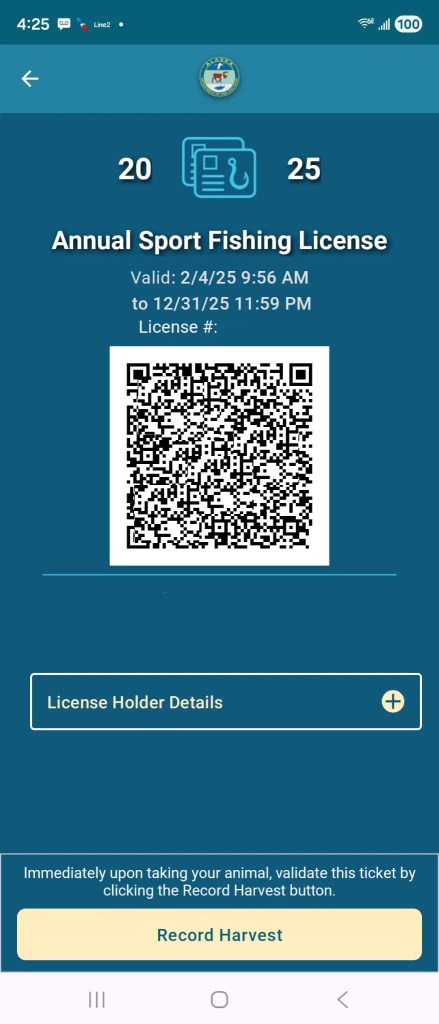
In 2025, you are no longer required to carry a physical paper license, provided you follow the state’s strict e-signature and display rules. Here is how to stay legal while going digital.

1. The Official ADF&G Mobile App

The best way to carry your license is through the official ADF&G Mobile App (available on iOS and Android).

  • Offline Access: The app stores a copy of your license locally. Crucial: You must open the app while you have internet access for at least two minutes before heading into the wilderness to ensure your data is synced for offline use.

  • Family Accounts: You can store licenses for your entire family (spouse, kids) on a single device, but you must be able to toggle between profiles if a Ranger asks to see them.

2. The “E-Signature” Requirement

A digital PDF of your license is not valid unless it is signed.

  • eSigned Format: If you buy your own license through your ADF&G account, it is automatically “eSigned” and 100% legal to display on your phone.

  • The “Photo” Method: If you have a physical license, you can take a picture of it. However, the physical license must be signed in ink before you take the photo for it to be valid in the field.

3. Recording Your Harvest (Kings & Halibut)

Even with a digital license, logging your catch is mandatory and must be done immediately.

  • In-App Logging: You can log your King Salmon or Halibut directly in the ADF&G app.

  • The Paper Backup: If your phone dies and you have no way to show your license or your harvest log, you are technically in violation.

  • Pro Tip: If you’re heading to a remote area with no charging ports, print a paper backup. Most Alaskans carry both: the app for convenience and a paper copy tucked into their tackle box for “just in case.”


📑 The "Hidden" Requirement: Harvest Record Cards

If you are fishing for species with annual limits—such as King Salmon, Halibut, or certain Rainbow Trout—a license is often only half of the requirement. Many anglers, especially youth and seniors, forget that they must carry a Harvest Record Card.

Do You Need One?

If you fall into any of the categories below, you must have a Harvest Record Card in your possession to fish for species with annual limits:

  • Resident Youth: Anyone under age 18.

  • Non-Resident Youth: Anyone under age 16.

  • Seniors (60+): Residents with a Permanent Identification Card (PID).

  • Disabled Veterans: Residents with a DAV license.

Note: If you bought a standard paid license (1-day, 7-day, or Annual), your harvest record is usually printed directly on the license. You do not need a separate card unless you run out of space.

✍️ The “Immediate” Rule

The State of Alaska is strict: you must record your catch immediately, in ink, before you even take the hook out of the fish (or as soon as it is landed).

  • What to record: The date, the location (water body), and the species.

  • Why it matters: Wildlife Troopers check these cards frequently. “I’ll write it down when I get back to the car” is not a valid excuse and can result in an on-the-spot fine.

Where to Get Yours (It’s Free!)

  • Physical Card: Available for free at any retail location that sells licenses (Walmart, Fred Meyer, local tackle shops).

  • Digital: You can record your harvest directly in the ADF&G Mobile App.

  • Printable: Download a PDF Harvest Record Card to keep in your tackle box as a backup.

2026 Fishing License FAQ
Residents: Required for ages 18–59.
Non-Residents: Required for ages 16 and older.
Note: Resident seniors (60+) and youth still need a free Harvest Record Card for specific species throughout the 2026 season.
Yes. A standard license is valid for all state waters. However, King Salmon require a separate paid stamp, and specific areas may require personal-use permits.
To qualify for the $20 resident rate, you must have been physically present in Alaska for the last 12 consecutive months with the intent to stay indefinitely.
Yes. Active-duty military and their dependents stationed in Alaska qualify for the resident-price license ($20) immediately upon arrival.
No. There is no additional fee for a Halibut stamp. However, you must record your catch immediately in ink on your Harvest Record Card. Be sure to check 2026 charter boat closures.
Check Current EOs. While the Kenai has faced multi-year closures, always check the 2026 Emergency Orders before heading out, as regulations are based on real-time sonar counts.
Yes—but only if the license was signed (digitally or in ink) before you took the screenshot. The ADF&G Mobile App is the preferred method for 2026.
If you cannot produce a signed license, you may be cited.
2026 Tip: Keep a paper backup in a Ziploc bag in your tackle box as a fail-safe.
The base fine is typically $200, plus surcharges. Fines increase if you have harvested fish in your possession without a valid license.
No, you do not need to mail it in. However, you should keep it through December 31, 2026, as proof of your annual harvest limits.

Halibut Only Charters

Halibut Combo Charters

Multispecies Charters

Overnight Charters